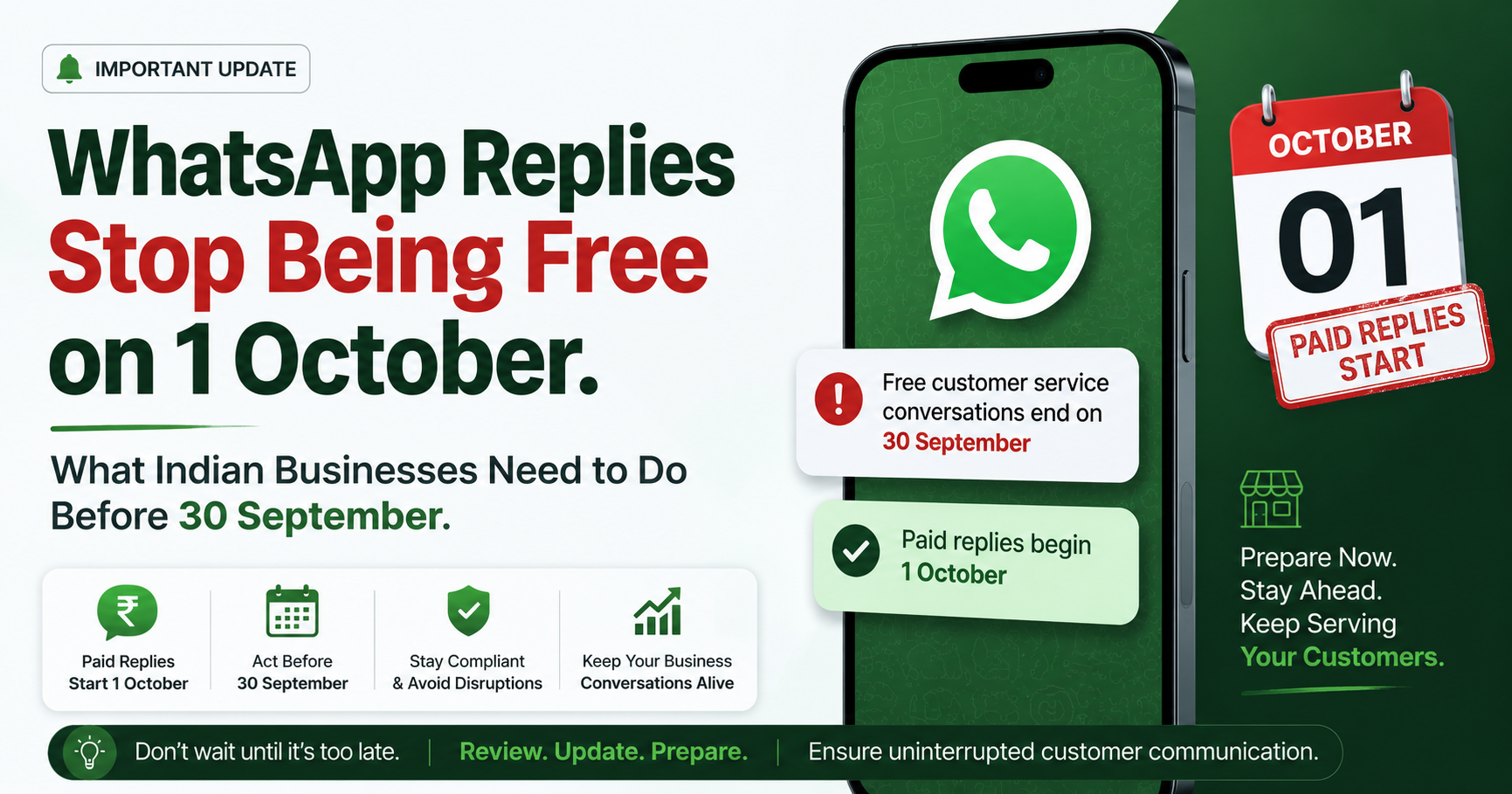
If your business answers customers on WhatsApp through the API, the replies your team types have been free to send since November 2024. That ends on 1 October 2026.
The change is narrow, and most of the coverage around it is wider and louder than the facts support. This is what is actually changing, what is not, and what is worth doing in the weeks before it starts.
What exactly changes on 1 October 2026?
Two things that are free today become billable on the WhatsApp Business Platform:
- Service messages. These are the free-form replies your team sends inside the 24-hour window a customer opens when they message you. Not templates, just ordinary replies typed by an agent or sent by your own bot.
- Utility templates sent inside that same service window. A delivery update or order confirmation sent while the window is open is free today. From 1 October it is charged like any other utility message.
Each service message will be charged at the same per-message rate as a utility template in the same country. That is the single most useful fact in this whole change, because your utility rate is already on your rate card. You do not need to wait for a new number to understand the shape of your exposure.
The 24-hour window itself is unchanged. It still opens when a customer writes to you, still runs for 24 hours, still resets on each new inbound message, and you still need an approved template to start a conversation outside it. Only the billing of what happens inside the window changes.
What stays free?
The headline overstates the case slightly, and the exceptions matter:
- The free WhatsApp Business app is not affected. If your team replies from the green WhatsApp Business app on a phone, none of this applies to you. This change is specific to the WhatsApp Business Platform, the API used directly or through a Business Solution Provider.
- Free entry point conversations keep their 72-hour window. When a chat starts from a Click-to-WhatsApp ad or a Facebook Page call-to-action button, messages delivered inside that 72-hour window remain free. For businesses running lead generation through Click-to-WhatsApp ads, a meaningful share of conversations may fall here.
- The consumer WhatsApp app is not affected in any way.
So it is not that WhatsApp replies stop being free. It is that replies inside the ordinary 24-hour service window stop being free, on the API, for conversations that did not begin with an ad click.
Why can nobody tell you what this will cost yet?
Because Meta has not published the rates.
Meta's own pricing documentation states that rate card updates are planned for 1 October 2026 and that the rates will be announced no later than 1 September 2026. At the time of writing, that announcement had not been made.
This is worth knowing because a great deal of the commentary already circulating quotes confident rupee figures. Those figures come from current utility rates, and published sources do not even agree with each other on what the current India utility rate is. If you are building a budget on a number you read in a blog post, check it against your own provider's rate card before you rely on it.
The mechanism is confirmed. The price is not. Plan against the mechanism.
What should Indian businesses do before 30 September?
The useful work here is measurement, not guesswork. Four things, in order.
-
Count your service messages. Pull the last 60 to 90 days from your provider's dashboard and separate outbound messages into three buckets: free-form replies inside the service window, utility templates inside the service window, and everything already billable. The first two buckets are your new cost. Most businesses have never had a reason to look at this split, because it has never mattered.
-
Work out your cost per resolved conversation. Take the two new-cost buckets, divide by the number of conversations they belong to, and you have the metric that actually matters after October: not what a message costs, but what answering one customer costs. A support thread that takes fourteen back-and-forth replies is now a different proposition from one that takes three.
-
Find the conversations that are long for the wrong reasons. Long threads caused by genuinely complex questions are fine. Long threads caused by asking for the order number three times, or by a first reply that did not answer the question, are about to have a line item attached. This is the one piece of preparation that pays off whether or not the rates land where you expect, because those threads were already costing you agent time and customer patience.
-
Check how much of your volume enters through Click-to-WhatsApp ads. Those conversations keep a 72-hour free window. If a large share of your inbound already arrives that way, your exposure is smaller than a raw message count suggests. If almost none does, that is worth knowing before you plan next quarter's acquisition spend.
When Meta publishes the rates, this preparation turns a week of scrambling into an afternoon of arithmetic: multiply your monthly counts by the published rate, add GST, and you have your number.
How do you estimate the cost without the rates?
Use the structure and fill in the price later:
(monthly service messages + monthly utility templates sent inside the window) × your country's utility rate × 1.18 = your added monthly cost
The 1.18 accounts for the 18% GST applied to these invoices in India, which is charged on top of Meta's listed rates rather than included in them. Businesses reading a rate card without accounting for GST will under-budget by nearly a fifth.
Run the formula with your current utility rate now to get a working figure, then substitute the real rate when it is published. If the two are close, you have already done the work. If they are not, you will at least know immediately.
One caution on volume discounts: utility and authentication messages attract volume-based discounts on some rate cards, so your effective rate may be below the list rate. Confirm with your provider rather than assuming either way.
What not to do
Do not migrate off WhatsApp on the strength of a headline. Moving a channel your customers already use is expensive, slow, and hard to reverse. The question is whether the channel still earns more than it costs, and you cannot answer that until you have both numbers. Get the measurement done, wait for the rate, then decide.
Do not try to dodge the change by pushing conversations into templates. Templates are billable too, and marketing templates cost considerably more than utility ones. Restructuring your support flow to avoid a charge you have not yet priced is how businesses end up paying more.
Do not cut replies to save money. A customer who does not get an answer does not become cheaper. They become someone else's customer. If a thread genuinely needs eight messages, it needs eight messages; the work is removing the threads that only need eight because something upstream is broken.
The change underneath the change
Since November 2024, the economics of WhatsApp support have rewarded volume. Replies were free, so an extra message cost nothing and there was no reason to count.
From October, every reply has a price. That does not make WhatsApp expensive — for most businesses the added cost will be modest against what the channel brings in — but it does make it measurable, and measurable channels get managed differently. The businesses that come out of this well will be the ones that already knew how many messages it took them to resolve a customer's problem.
That is a number worth having regardless of what Meta announces on 1 September.
Sources
Verify against the primary source before making budget decisions. Meta's pricing documentation is the authority on rates and effective dates:
Your own provider's rate card is the authority on what you specifically pay, including any volume discounts and how GST is applied to your invoices.